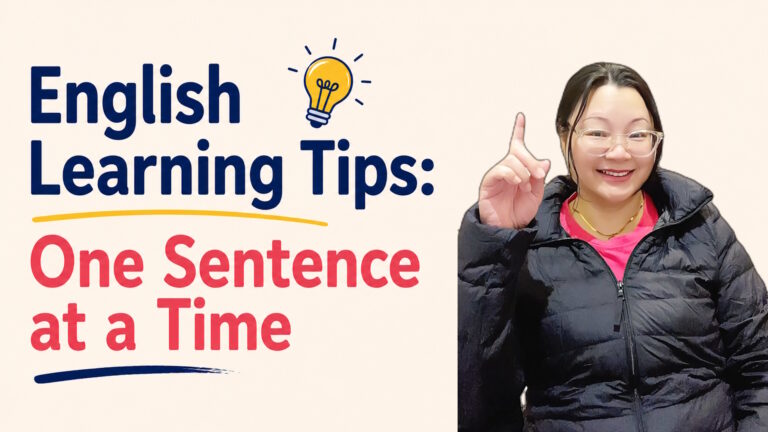
Do you understand English but still struggle to speak fluently? In this lesson, I share the real reason many English learners freeze when they try to speak — and why it is often not about grammar or vocabulary. Watch the video below first, and if you prefer reading, you can also find the full article underneath.
Watch the Video First
Prefer reading? The full article is below.
Have you spent many years learning English, but you still can’t speak fluently?
Maybe you have memorised vocabulary lists, listened to English videos every day, watched movies, and followed many teachers. But when it is time to open your mouth, you freeze. You panic. You suddenly cannot speak.
If this sounds like you, I want you to know something very important:
The number one mistake many English learners make is not grammar, and it is not vocabulary. It is being afraid of making mistakes.
We spend so much time listening. We spend so much time memorising. But many learners spend almost no time actually speaking.
Why?
Because we are afraid.
We are afraid of choosing the wrong word.
We are afraid of pronouncing something incorrectly.
We are afraid of grammar mistakes.
We are afraid of sounding “not good enough.”
But here is the truth:
If you don’t open your mouth, your speaking muscles will never learn English.
Fear Is One of the Biggest Reasons You Can’t Speak English Fluently
Many learners think the reason they cannot speak fluently is because they do not know enough words or because their grammar is not good enough.
Of course, vocabulary and grammar matter. But very often, they are not the real reason.
The real reason is this:
you are afraid to speak.
You may understand a lot when you listen. You may recognise words when you read. But speaking is different. Speaking is active. Speaking requires confidence, muscle memory, and practice.
That is why so many learners say:
- “I can understand English, but I can’t speak.”
- “I know the words, but I can’t say them.”
- “I feel nervous when I try to speak English.”
This is more common than you think.
And the good news is: this problem can be improved.
My Own Story: Why Speaking Takes More Than Knowledge
Let me tell you my own story.
My native language is Chinese, and in my hometown dialect, we do not really have the N sound. So when I spoke English, I did not even realise that I was pronouncing N incorrectly.
To me, it sounded normal.
In my dialect, L and N sound almost the same. My brain had never clearly learned the difference.
One day, a very sweet viewer sent me a message and said:
“Amelia, I love your videos, but I won’t tell anyone that my teacher doesn’t know how to pronounce N.”
That was the first time I truly realised:
Oh. I really cannot pronounce N correctly.
So I started practising.
I practised for one month.
Then three months.
Then six months.
Then one whole year.
I kept opening my mouth and trying again and again. But I still could not say it properly, because my brain had never truly heard that sound since I was born.
Then one day, while I was driving, I heard someone on the radio say a very strong, very clear N sound.
And suddenly, something changed.
My brain recognised it.
My mouth recognised it.
My muscles finally learned it.
That moment changed everything for me.
Sometimes the Problem Is Not Grammar — It Is Muscle Training
This is why I want to tell English learners something important:
Sometimes the problem is not grammar. Sometimes the problem is not vocabulary. Sometimes the problem is muscle training.
Your mouth, tongue, lips, and facial muscles need practice.
Your speaking muscles need training.
And muscles can only be trained by speaking.
Some learners struggle with V.
Some struggle with R.
Some struggle with L.
Some struggle with N.
Why?
Because their first language or dialect may not use those sounds in the same way.
So please remember this:
It is not always your fault.
It does not mean you are bad at English.
It does not mean you are not smart enough.
It simply means your speaking muscles need time and practice.
Why You Freeze When You Speak English
Many English learners freeze when they try to speak because they are carrying too much fear.
They are thinking:
- “What if I say it wrong?”
- “What if my pronunciation is strange?”
- “What if people judge me?”
- “What if my English is not good enough?”
But if you wait until everything is perfect, you may never start.
And if you never start, your spoken English will never grow.
This is why fear is so dangerous.
Mistakes do not stop your English. Fear stops your English.
You do not become fluent by staying silent.
You become fluent by speaking, noticing, adjusting, and trying again.
You Should Be Proud of Yourself for Learning English
Many people are afraid to speak because someone might say:
- “Your pronunciation is not native enough.”
- “Your English is not good enough.”
But I want to tell you something different.
The moment you start learning English, you are already doing something brave.
If you speak your native language and you are learning English, that means you already know at least two languages, or you are building toward that.
Do you know how powerful that is?
There are many people who speak only one language in their whole life. But you are learning another language. You are challenging your brain. You are stretching yourself. You are growing.
That makes you brave.
That makes you intelligent.
That makes you special.
So please do not be ashamed of your mistakes.
Be proud of your effort.
Be proud of your growth.
Be proud of the fact that you are learning something difficult and valuable.
How to Fix It: Start Speaking English More Fluently
If you want to speak English more fluently, do not wait until you feel 100% ready.
Start small.
Open your mouth.
Say one sentence.
Then say another one.
Practise every day.
Train your muscles.
Let your mouth get used to English.
Fluency does not come from silence.
Fluency comes from practice.
You do not need to speak perfectly today. You just need to start.
Here is what I want you to remember:
- Don’t waste your life being afraid of mistakes.
- Your English muscles will not grow if you never speak.
- Start today.
- Open your mouth.
- Say one sentence.
Because mistakes will not stop you.
Fear will.
Final Thoughts
If you understand English but still cannot speak fluently, please do not be too hard on yourself.
For many learners, the real problem is not a lack of intelligence. It is not laziness. It is not even grammar.
Very often, it is fear.
And fear can be overcome.
Step by step, sentence by sentence, your speaking can improve.
So be proud of yourself. Be patient with yourself. And be brave enough to speak now.
That is the only way to truly learn English.
❤️
Learn English with Amelia
Hi, I’m Amelia. If you are learning English and want to improve step by step, you are very welcome to explore more lessons on my website and subscribe to my YouTube channel.
Let’s learn together and improve together.